
ASEAN-ERAT Pre-Learning Materials and Interactive Modules
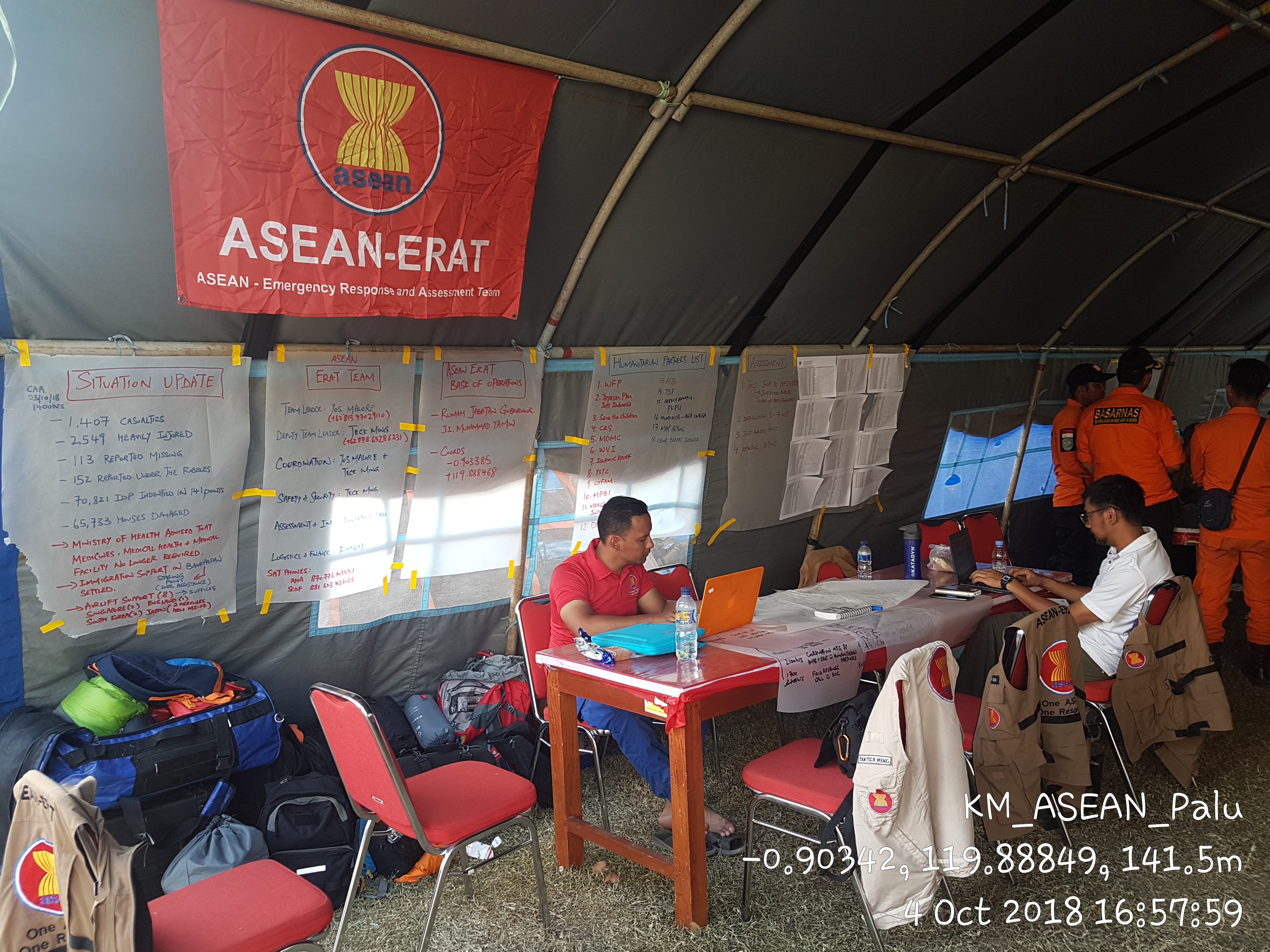
Reading materials, references, and interactive modules for the ASEAN-ERAT Induction.
The following reading materials and references are available:
1. The ASEAN-ERAT System
2. International Humanitarian System: Tools and Services
3. ASEAN DM - ASEAN Charter
4. ASEAN DM - Other Reference Documents
5. ASEAN DM - AADMER
6. ASEAN DM - AHA Centre
7. The AHA Centre Crisis Communication (ACT) Guidelines
The following interactive modules are available:
1. What is ASEAN-ERAT?
2. Mission Cycle
3. Facilitation of Incoming Assistance
4. Coordination
5. Assessment
6. Introduction to WebEOC
7. Safety and Security
Section outline
-
-
CompletionStudents mustView
The Sphere community sets standards for humanitarian action and promotes quality and accountability worldwide. Read this charter to gain an understanding to the basis of Sphere standards
-
CompletionStudents mustView
Handbook of the Sphere International Humanitarian Standards. After reading the previous Charter, we encourage you to read this handbook to gain a thorough understanding of the Sphere International Humanitarian Standards, as a basis for humanitarian operations around the world.
-
CompletionStudents mustView
Short summary of humanitarian principles by the United Nations Office for the Coordination of Humanitarian Affairs (UNOCHA),
The humanitarian principles of humanity, neutrality, impartiality and independence provide the foundation for humanitarian action. They are central to establishing and maintaining access and delivering humanitarian assistance to affected people, whether in a disaster or a complex emergency, such as armed conflict. Promoting and ensuring compliance with the principles are essential for effective humanitarian coordination and response.
-
CompletionStudents mustView
This book provides a useful rundown of available tools and services of disaster response and humanitarian aid, especially in the Asia and Pacific context.
-
CompletionStudents mustView
Further elaboration on the tools and services of the international humanitarian system, presented by the UNOCHA. After reading these materials, we expect you to gain a better understanding of the international humanitarian system which will be the basis of ASEAN-ERAT operations.
-
-
-
CompletionStudents mustView
The ASEAN Charter serves as a firm foundation in achieving the ASEAN Community by providing legal status and institutional framework for ASEAN. It also codifies ASEAN norms, rules and values; sets clear targets for ASEAN; and presents accountability and compliance.
This lesson gives a very basic overview of the ASEAN Charter and the structure of the ASEAN Communities. This will get you familiar with disaster management architecture to be discussed during the class.
Read the ASEAN Charter, particularly pages 5-13. Reflect on the following:
- What are purposes of ASEAN?
- What are the principles of ASEAN that you do not understand?
- What does it mean for your country to be part of ASEAN?
-
CompletionStudents mustView
Short video summary on the history and purpose of ASEAN.
-
-
-
CompletionStudents mustView
AADMER serves as a common platform and regional policy backbone for disaster management in the ASEAN region.
Read the regional agreement and reflect on the following:- What are the two objectives of AADMER?
- What are the six principles of AADMER?
- What are the key actions for disaster management provided for in AADMER?
- Which agencies are responsible for the implementation of AADMER?
- What are the sources of funds for the implementation of AADMER?
There are several strategic documents for the implementation of AADMER, namely:
- ASEAN Vision on Disaster Management 2025
- AADMER Work Programme (AWP) 2021-2025
- Standard Operating Procedures for Regional Standby Arrangements and Coordination of Joint Disaster Relief and Emergency Response (SASOP)
- ASEAN Joint Disaster Response Plan (AJDRP)
- Operationalising One ASEAN One Response (OAOR)
You will find these documents in the section on Other Reference Documents below.
-
-
The following are the reference documents to better understand the ASEAN disaster management mechanisms:
-
CompletionStudents mustView
ASEAN Vision on Disaster Management 2025
This strategic policy document outlines the directions that may be considered by ASEAN, and identifies the key areas to move the implementation of AADMER forward to a people-centred, people-oriented, financially sustainable, and networked approach from 2015 to 2025.
Reading guide questions:
- What are the three mutually-inclusive strategic elements of the vision?
- What types of disasters should ASEAN respond to?
-
CompletionStudents mustView
AADMER Work Programme 2021 - 2025
AADMER Work Programme outlines a detailed structure of activities of the region’s disaster management priorities over five-year periods (2021-2025)
In the next five (5) years, the AADMER will be carried out through five (5) priority programmes that reflect its major provisions. These priority programmes are:
- Risk Assessment and Monitoring (RAM)
- Prevention and Mitigation (P&M)
- Preparedness and Response (P&R)
- Resilient Recovery (RR)
- Global Leadership (GL)
Reading guide questions:- What are the key outputs in each of the Priority Programmes?
- In which priority programme does your own area of work (job) align with?
-
CompletionStudents mustView
SASOP provides:
(i) the guides and templates to initiate the establishment of the ASEAN Standby Arrangements for Disaster Relief and Emergency Response;
(ii) the procedures for joint disaster relief and emergency response operations;
(iii) the procedures for the facilitation and utilisation of military and civilian assets and capacities, and;
(iv) the methodology for the periodic conduct of the ASEAN Regional Disaster Emergency Response Simulation Exercises (ARDEX) which shall test the effectiveness of these procedures.
Reading guide questions:- What are the different forms through which ASEAN Member States communicate about impending disasters, requests and offers of assistance?
- What are Standby Arrangements? Are they obligatory or voluntary?
-
CompletionStudents mustView
ASEAN Joint Disaster Response Plan
The AJDRP is a plan to provide a common framework to deliver a timely, at-scale and joint response through mobilisation of required assets and capacities.
Reading guide questions:
- Who can be involved in the ASEAN joint disaster response?
- What are the three scenarios for catastrophic disasters in ASEAN? Why are these relevant to all ASEAN Member States?
- What are the types of resources or modules that ASEAN should prepare for?
-
CompletionStudents mustView
Operationalising One ASEAN One Response
One ASEAN One Response is about ASEAN responding to disasters in the region and outside the region as one – that is, having as many relevant stakeholders involved to achieve the envisioned speed, scale and solidarity. It is an open and inclusive platform using ASEAN’s mechanisms at its core.
Reading guide questions:
- What are the three objectives of One ASEAN One Response?
- How will these objectives be measured?
-
CompletionStudents mustView
Handbook of the ASEAN Regional Disaster Emergency Response Simulation Exercise (ARDEX)
ARDEX or the ASEAN Regional DIsaster Emergency Simulation Exercise is an regular full-scale simulation exercise aimed at testing, practising, reviewing, and evaluating ASEAN's response and disaster management mechanisms. Read this guide to obtain a better understanding of the mechanisms and procedures as well as the role and significance of ARDEX in ASEAN's disaster management.
-
-
The AHA Centre is an intergovernmental organisation, established by the ten ASEAN Member States with the aim to facilitate cooperation and coordination of disaster management amongst ASEAN Member States. The Agreement on the Establishment of the ASEAN Coordinating Centre for Humanitarian Assistance on disaster management was signed by ASEAN Foreign Ministers on 17 November 2011, and witnessed by the Heads of State / Government of all ten ASEAN countries.
In operationalising its mandate, the AHA Centre primarily works with the National Disaster Management Organisations (NDMOs) of the ASEAN Member States. Furthermore, the AHA Centre also partners with international organisations, private sector, and civil society organisations, such as the Red Cross and Red Crescent Movement, the United Nations, and AADMER Partnership Group.-
CompletionStudents mustView
Agreement by the ASEAN member states on the foundation of the AHA Centre
-
CompletionStudents mustView
Short video profile on the AHA Centre. Watch this video to gain an understanding on the AHA Centre's history, role, and structure.
-
CompletionStudents mustView
A short presentation on the AHA Centre.
-
-
The ACT Handbook provides guidelines and practices for communications in disaster time.
-
CompletionStudents mustView
This AHA Centre Crisis Communications (The ACT) handbook is designed to provide topline information and guidance during a crisis situation. In this handbook, you will find direction for communications during disaster and crisis situations in the ASEAN region.
-
-
-
CompletionStudents mustView
Guidelines for the operations of the ASEAN Emergency Rapid Assessment Team
-
-
The following are a series of interactive modules to help you understand the ASEAN-ERAT system and operations, divided into the following topics
---
1. What is ASEAN-ERAT?
2. Mission Cycle
3. Facilitation of Incoming Assistance
4. Coordination
5. Assessment
6. Introduction to WebEOC
7. Safety and Security
-
CompletionStudents mustViewComplete the activity
An interactive introduction on the ASEAN-ERAT, its history, its role, and core functions
-
CompletionStudents mustViewComplete the activity
An interactive overview of the ASEAN-ERAT Mission Cycle.
-
CompletionStudents mustViewComplete the activity
Short interactive module on the topic of Facilitation of Incoming Assistance in ASEAN-ERAT operations.
-
CompletionStudents mustViewComplete the activity
Interactive module on the topic of Assessment in ASEAN-ERAT operations.
-
CompletionStudents mustViewComplete the activity
Interactive module on the topic of Coordination in ASEAN-ERAT operations
-
CompletionStudents mustViewComplete the activity
An introduction to the WebEOC website and information system for ASEAN-ERAT members.
-
CompletionStudents mustViewComplete the activity
An advanced introduction to the usage of WebEOC in ASEAN-ERAT Operations
-
CompletionStudents mustViewComplete the activity
Interactive module on the topic of Safety and Security during ASEAN-ERAT operations.
-